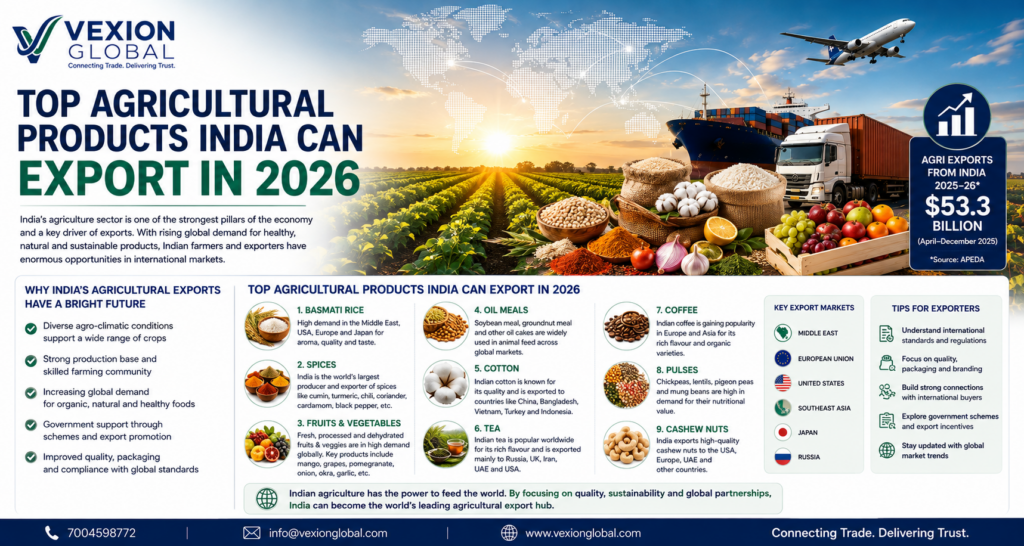
Agricultural exports are already an important part of India’s international trade. According to APEDA’s Farmer Connect data, India’s agricultural exports, including cotton, were worth about US$51.91 billion in 2024–25, while APEDA-monitored products accounted for approximately US$27.90 billion. India exports agricultural and processed food products to more than 200 countries and regions.
The opportunity in 2026 is not limited to traditional commodities. Increasing demand for processed, packaged, organic and value-added agricultural products is creating opportunities for Indian farmers, processors, manufacturers and exporters.
1. Basmati and Non-Basmati Rice
Rice remains one of India’s strongest agricultural export products.
In 2024–25, India exported approximately 14.13 million tonnes of non-basmati rice worth US$6.53 billion, while basmati rice exports were approximately 6.07 million tonnes worth US$5.94 billion.
Major markets include countries in the Middle East, Africa, Asia, Europe and North America.
Export opportunities include:
- Basmati rice
- Non-basmati rice
- Parboiled rice
- Broken rice
- Organic rice
- Rice flour and other value-added products
Rice exporters should pay close attention to changing registration, documentation and destination-country requirements. APEDA has issued specific procedures for rice exports to markets such as China and Saudi Arabia during 2026.
2. Indian Spices
India’s reputation as a major spice-producing country gives exporters an established global advantage.
Popular export products include:
- Turmeric
- Cumin
- Coriander
- Black pepper
- Cardamom
- Chilli
- Ginger
- Curry powder
- Spice blends
Spices can be exported either as whole products or in processed forms such as powders, blends and packaged consumer products.
However, exporters need to take food safety and pesticide-residue requirements seriously. Recent international scrutiny of Indian agricultural shipments demonstrates how important compliance with destination-country Maximum Residue Limits (MRLs) has become.
3. Fruits and Vegetables
India’s diverse climate allows it to produce a wide variety of fruits and vegetables.
APEDA’s latest export data shows substantial exports of fresh fruits and vegetables. During April–June 2026, fresh-fruit and vegetable exports included significant quantities of onions, other fresh vegetables, grapes and mangoes.
Potential export products include:
- Mangoes
- Grapes
- Pomegranates
- Onions
- Okra
- Potatoes
- Garlic
- Bananas
- Fresh vegetables
There are also opportunities in dehydrated, frozen and processed fruits and vegetables, which can reduce some of the logistical challenges associated with fresh produce.
4. Processed Fruits, Juices and Food Products
Value-added agricultural products are becoming increasingly attractive because exporters can move beyond selling raw commodities.
Products include:
- Mango pulp
- Fruit juices
- Pickles
- Jams and jellies
- Canned vegetables
- Frozen vegetables
- Dehydrated fruits
- Processed nuts
- Gherkins
APEDA reports that processed fruits, juices and nuts generated approximately US$662.79 million in exports during FY2025–26, with the Netherlands, United States, UAE, Saudi Arabia and UK among major destinations.
For MSMEs, processing can create an opportunity to build branded products rather than competing solely on commodity prices.
5. Pulses
Pulses are another promising agricultural category.
Indian and South Asian food consumption creates established demand internationally, while health-conscious consumers globally are increasingly interested in plant-based protein.
Export opportunities include:
- Chickpeas
- Lentils
- Pigeon peas
- Mung beans
- Kidney beans
- Processed pulse products
- Pulse flour
APEDA’s latest data shows pulses were among the major processed agricultural export categories, with approximately US$367.10 million in exports during April–June 2026.
Exporters should, however, monitor India’s domestic supply situation and government policies because agricultural export rules can change depending on domestic availability and food-security considerations.
6. Coffee
Indian coffee has a strong reputation for its distinctive flavour profiles and growing global recognition.
Export opportunities exist in:
- Green coffee beans
- Roasted coffee
- Ground coffee
- Instant coffee
- Specialty coffee
- Organic coffee
European markets, the Middle East, Asia and North America can provide opportunities for Indian coffee businesses.
The greatest opportunity for smaller businesses may lie in specialty and branded coffee, where exporters can differentiate themselves through origin, quality, processing method and packaging.
7. Tea
Indian tea is another globally recognized agricultural product.
Products include:
- Assam tea
- Darjeeling tea
- Nilgiri tea
- Black tea
- Green tea
- Organic tea
- Specialty tea blends
Rather than exporting only bulk tea, Indian businesses can explore branded and premium packaged products.
This approach can potentially generate higher margins and create stronger relationships with international retailers and distributors.
8. Oilseeds and Oil Meals
Oil meals are an important component of India’s agricultural export basket.
Products such as soybean meal, groundnut meal and other oil cakes are used as animal-feed ingredients in international markets.
APEDA’s 2024–25 data places oil meals among India’s major agricultural export commodities.
Exporters can explore markets where demand for feed ingredients is growing, while ensuring compliance with destination-country feed safety and quality standards.
9. Groundnuts and Cashew Nuts
India is also well positioned in the global nut market.
Groundnuts have established export demand, while Indian cashews have strong recognition in international markets.
Potential products include:
- Raw groundnuts
- Roasted peanuts
- Peanut products
- Cashew kernels
- Roasted cashews
- Flavoured nuts
- Packaged premium nuts
Value addition can be particularly attractive in this segment because branded and consumer-ready products can command higher prices than bulk commodities.
Which Countries Should Indian Agricultural Exporters Target?
Choosing the right destination is just as important as choosing the right product.
Potential markets include:
Middle East
The UAE, Saudi Arabia, Oman, Qatar and other Gulf markets offer opportunities for rice, spices, fruits, vegetables, processed foods and other Indian agricultural products.
European Union
European markets offer opportunities for premium, organic and processed products, but exporters must pay close attention to food safety, pesticide residues, traceability and packaging regulations.
United States
The US remains one of India’s major agricultural export destinations. However, exporters need to consider changing tariff policies and strict food-safety requirements.
Southeast Asia
Countries in Southeast Asia can offer opportunities for rice, spices, fruits, vegetables, coffee and processed foods.
Japan
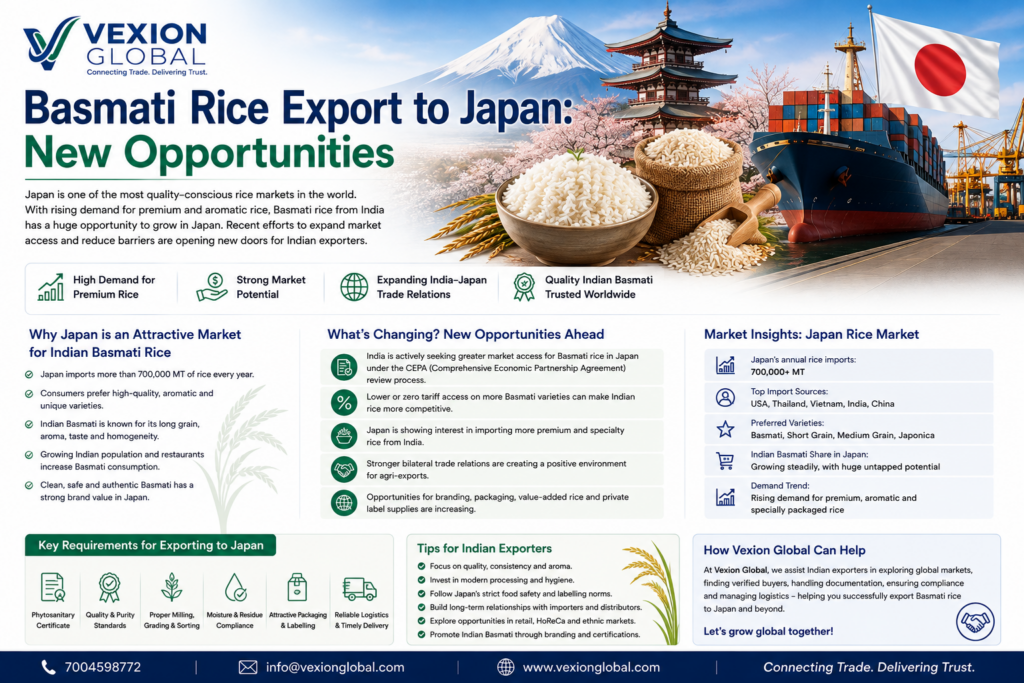
Japan can be an attractive premium market, but exporters must meet stringent quality and food-safety standards. India’s efforts to expand market access for products such as basmati rice make this market worth monitoring.
Why Value Addition Will Matter in 2026
One of the biggest opportunities for Indian agricultural exporters is moving from commodity exports to value-added exports.
Consider the difference:
Mango → Mango Pulp → Mango Juice → Branded Mango Beverage
or:
Turmeric → Turmeric Powder → Organic Turmeric → Branded Retail Pack
Value addition can provide:
- Better margins
- Longer shelf life
- Easier transportation
- Greater brand recognition
- Access to retail markets
- Reduced dependence on commodity prices
India’s Agriculture Export Policy also emphasizes diversification, value-added agricultural exports, market access and development of infrastructure for agricultural exports.
Challenges Indian Agricultural Exporters Need to Address
Agricultural exports can be highly profitable, but they also involve significant risks.
1. Quality Standards
International buyers often require consistent quality across shipments.
2. MRL Compliance
Pesticide residue limits vary between countries. Exporters need suitable testing and farm-level compliance systems.
3. Cold Chain
Fresh fruits and vegetables require appropriate storage and transportation.
4. Packaging
Packaging must protect the product and comply with destination-country labelling regulations.
5. Export Policy Changes
Agricultural products can sometimes be subject to export restrictions, minimum export prices, quotas or other policy measures.
6. Buyer Verification
Exporters should carefully verify foreign buyers before accepting large orders or extending credit.
How to Start Exporting Agricultural Products from India
Businesses considering agricultural exports should follow a structured process:
- Select a product based on production capacity and international demand.
- Identify target countries with suitable demand and market access.
- Check the HS code and applicable export policy.
- Study destination-country regulations.
- Arrange necessary registrations and certifications.
- Develop export-quality packaging.
- Calculate the complete landed cost.
- Find and verify international buyers.
- Negotiate payment and shipping terms.
- Prepare export documentation and arrange logistics.
Businesses should also monitor APEDA notifications because export procedures and market requirements can change. Recent APEDA notices, for example, cover rice exports, sugar tariff-rate quotas and other agricultural trade requirements.
Conclusion
India has enormous potential to expand agricultural exports in 2026. Rice, spices, fruits and vegetables, processed foods, pulses, coffee, tea, oil meals, groundnuts and cashews are among the categories that Indian businesses can explore.
The opportunity, however, is not simply about producing more.
The future of India’s agricultural exports will depend on quality, processing, packaging, traceability, compliance, cold-chain infrastructure and access to reliable international buyers.
Businesses that move toward value-added products and understand the requirements of individual foreign markets can build more sustainable export businesses.
For Indian farmers, processors, manufacturers and MSMEs, the global agricultural market offers significant opportunities—but success will come from treating agricultural exports as a professional international business rather than simply selling surplus production overseas.
Vexion Global can help businesses navigate the export journey—from identifying international opportunities and buyers to documentation, compliance and global trade execution.